


While a basic V/f drive is like giving a motor simple on/off instructions, vector control is akin to providing it with a detailed map and a precise navigation system-transforming crude movement into orchestrated motion.
At the heart of modern industry, where a machine tool spindle must maintain perfect speed under shifting loads or a crane must lift with unwavering torque, the evolution from V/f control to vector control represents a fundamental leap forward in capability.
This transition has moved motor control from a method of approximation to one of exact command, unlocking performance once thought impossible for standard AC motors.
1 The Limits of V/f Control: A One-Dimensional Approach
V/f (Voltage-per-Hertz) control, the traditional method for regulating AC motor speed, operates on a simple principle: change the frequency to adjust speed, and proportionally adjust the voltage to maintain magnetic flux. In essence, it treats the motor as a single-input device.
Think of it as controlling a car using only the accelerator pedal. Pressing harder increases speed, but you have no independent control over the torque at the wheels to climb a steep hill or respond to a sudden load. Torque and speed remain inseparably linked.
This scalar control method manages only the magnitude of electrical inputs while completely ignoring their phase relationships. As a result, it faces several inherent limitations: significant torque loss at low speeds, slow response to load fluctuations that causes speed droop, and an inability to deliver controlled, high starting torque. Its behavior is reactive rather than directive.
2 The Core Breakthrough: Decoupling Torque and Flux
The theoretical breakthrough of Field-Oriented Control (FOC), or vector control, in the 1970s changed everything. Its genius lies in a concept known as decoupling.
Engineers discovered that the precise, independent control of torque and magnetic flux seen in DC motors could be replicated in AC motors through mathematical innovation. By applying advanced transformations-such as the Clarke and Park transforms-they were able to electronically unravel the motor's complex AC currents.
This approach instantaneously separates the current into two distinct, computable components within the digital control system: one dedicated solely to producing magnetic flux and the other responsible for generating torque. With this separation, the controller can regulate these two forces independently and simultaneously, as if adjusting two separate dials.
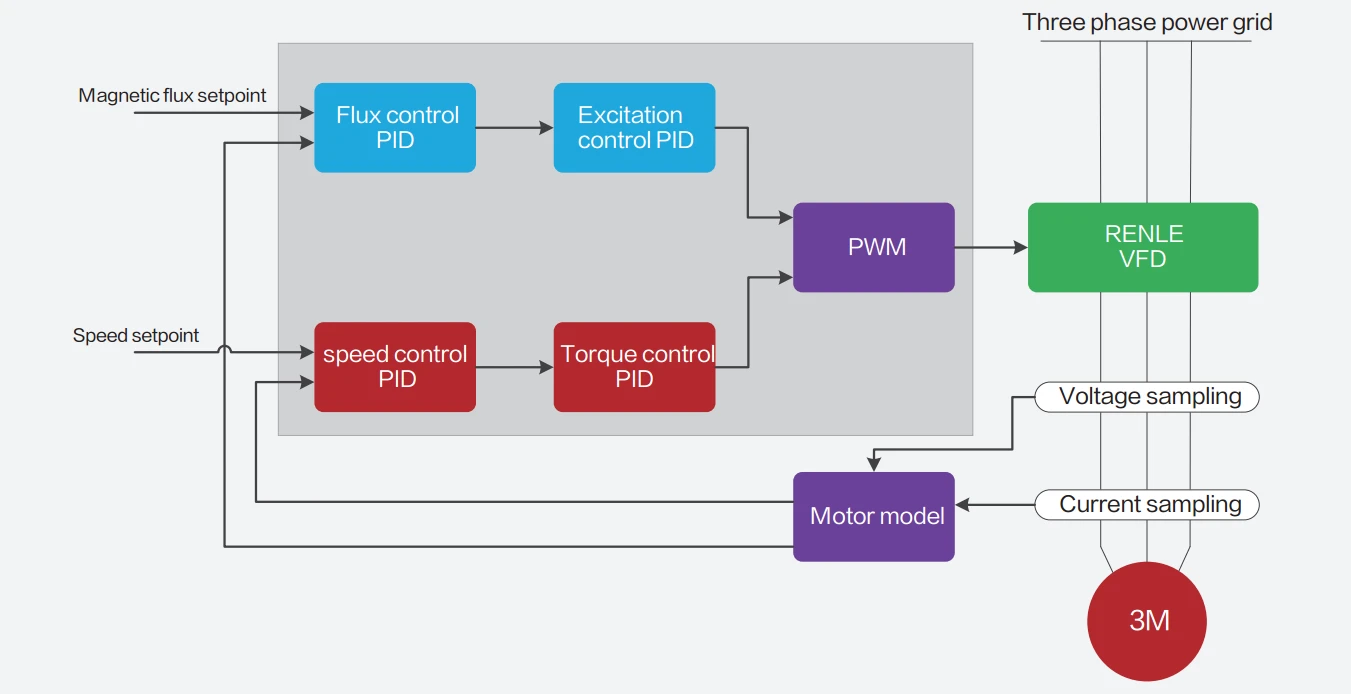
3 The Performance Dividend: Precision, Power, and Response
Decoupling delivers transformative performance advantages. First, it enables full torque at zero and low speeds. Applications such as extruders, hoists, and conveyors-where high breakaway force is needed to overcome inertia-can start smoothly and powerfully without the risk of stalling.
Second, it provides exceptional dynamic response. Because torque is now a directly commanded variable rather than a secondary effect, the drive can adjust it within milliseconds to counteract load disturbances. This allows the motor to maintain nearly constant speed regardless of load changes-a critical requirement for machine tools, winders, and test stands.
Precision also dramatically improves speed regulation. While V/f control typically holds speed within ±1–2%, advanced closed-loop vector control systems can achieve regulation as tight as ±0.02%, enabling synchronized operation across multiple drives.
4 Implementation Pathways: From Sensorless to Full Feedback
Vector control is typically implemented in two tiers, giving engineers the flexibility to balance cost, performance, and system complexity. Sensorless Vector Control relies on high-fidelity motor models embedded in the drive to estimate speed and rotor position, eliminating the need for an external encoder. This approach offers strong torque response and stable operation, making it a practical choice for pumps, fans, compressors, and general-purpose machinery.
For applications that demand the highest precision-centrifuges, high-speed spindles, lifting systems, and advanced test equipment-Closed-Loop Vector Control with an encoder is the preferred architecture. By providing real-time rotor feedback, the encoder closes the control loop, unlocking maximum speed accuracy, torque precision, and stability. This enables an AC induction motor to deliver performance characteristics approaching those of a servo system.
The comparison below illustrates the significant performance gap between these two control strategies:
| Feature | V/f Control | Sensorless Vector Control | Encoder-Based Vector Control |
| Control Basis | Scalar, voltage/frequency ratio | Vector, model-based estimation | Vector, direct encoder feedback |
| Low-Speed Torque | Poor, requires boost | Excellent (~150% torque at <1 Hz) |
Superior (full torque at 0 RPM) |
| Speed Regulation |
2-5% of base speed |
0.2-0.5% of base speed |
0.01-0.02% of base speed |
| Dynamic Response | Slow (100+ ms) | Fast (10-50 ms) | Very Fast (1-10 ms) |
| Typical Cost | Lowest | Moderate | Higher |
| Best Applications | Pumps, fans (simple loads) | Conveyors, mixers, general machinery | Machine tools, winders, cranes, high-precision systems |
5 Engineering Reality: Translating Theory into Product Specs
The real impact of vector control becomes tangible when you look at a drive's specifications. A traditional V/f inverter might advertise speed accuracy of "±2%," while a vector-controlled drive confidently states "±0.2%." Torque response, once described vaguely in general terms, is now quantified with precision-often in the range of "<5 ms." These numbers represent not marketing flourish but the measurable outcome of decades of control-algorithm evolution.
In Renle's product lineup-from versatile general-purpose inverters to the heavy-duty RNHV series designed for large industrial loads-vector control is not an optional feature; it is the foundation. It enables smooth, powerful starts that far outperform electromechanical soft starters, and it provides the tight, stable control required by demanding equipment such as high-capacity compressors, crushers, fans, and process motors in mining, cement, and water treatment facilities.


Consider a bottling plant: a vector-driven motor brings a labeling system to its exact operating speed in milliseconds, holds that speed through rapid load changes, and stops with surgical accuracy-cycle after cycle, shift after shift. This quiet, unbroken precision is the direct result of the industry's shift from simple V/f control to vector control.
That shift didn't just improve motor performance; it redefined what an AC motor could be. It transformed the induction motor from a rugged workhorse into an instrument of precision, setting the stage for the next era of innovation, where advanced algorithms such as Model Predictive Control (MPC) are poised to push efficiency, responsiveness, and intelligence even further.